Why are slabs ground?
Slabs are feedstock for further industrial processing. Their surface condition influences their suitability for the next production step. Depending on the initial condition, scale, near-surface cracks or other surface defects may require treatment.
Grinding removes material selectively from the surface. The aim may be to remove individual defects, condition larger areas or reach a specified thickness. The required scope follows from the slab condition and subsequent processing requirements.
Individual defects or the entire surface?
Where defects are localised, selective grinding may be appropriate. Their location and extent should be described or marked as precisely as possible. Photographs and existing inspection results help with the initial assessment.
Full-surface processing may be appropriate where larger areas are affected or a continuous surface needs treatment. Choosing between local and full-surface grinding affects material consumption, processing time and remaining dimensions.
A planning example: for individually marked defects, removal of those defects is the priority. If the entire slab must be ground to a specified thickness, initial dimensions, sides to be processed and permissible thickness variations must be considered together.
Stone grinding and belt grinding
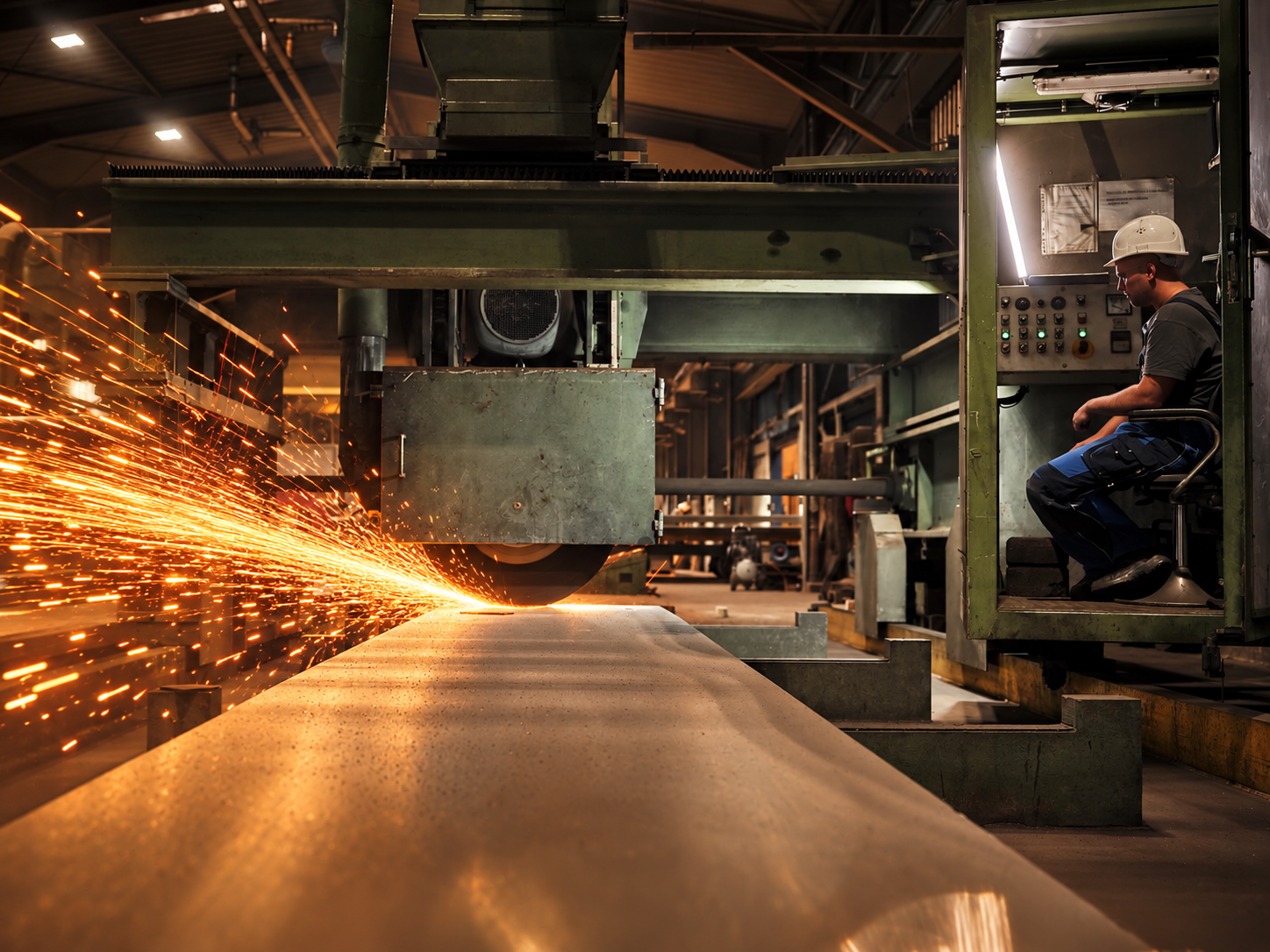
BEB uses stone and belt grinding machines for industrial steel reconditioning. Stone grinding can remove surface defects locally or across larger areas. It can also be used to grind material to a required thickness.
Depending on the workpiece and processing target, belt grinding may be suitable for further surface and thickness processing. The appropriate method or combination depends on steel grade, initial condition, dimensions, removal requirements and desired finish.
The process name alone does not define the finished result. Processing scope, target dimensions and any roughness requirements should therefore be agreed in advance.
Grinding slabs to a specified thickness
Where a final thickness is required, the processor needs the initial thickness and any existing thickness variations. The permissible deviation from the target and the sides to be processed must also be specified.
Sufficient material must remain after local defect removal too. A defect may extend deeper than initially apparent. Minimum thickness and maximum permissible removal should therefore be agreed. If both requirements cannot be met, further agreement is needed.
Thickness, flatness and surface roughness are different characteristics. A slab ground to thickness does not automatically satisfy every additional requirement for shape or finish. Specify these separately.
What are the limits?
Grinding acts on accessible surfaces. Internal material defects cannot automatically be eliminated by surface processing alone. A visually clean ground surface is also not sufficient evidence that the material is completely free of defects.
If a particular defect check or documented inspection is required, the method, scope and acceptance criteria must be agreed separately. Existing inspection reports should accompany the enquiry.
Material condition, geometry, individual weight and available machining allowance also affect feasibility. Processing capabilities are therefore assessed for the particular feedstock.
When slab grinding is economical
Grinding is economically attractive when the conditioned feedstock enables the intended next process or reduces additional effort in that process. Grinding costs, material loss, handling and transport must all be considered.
Limited processing may be appropriate when only individual areas are affected. Full-surface grinding can be the right solution where required by the agreed dimensions or surface condition. The decisive factor is the quality actually needed for the next step.
For repeat deliveries, clear material, initial-condition and processing specifications make costs easier to compare. Without these details, a general claim about economic value is not meaningful.
What BEB needs for your enquiry
Specify steel grade and material condition, thickness, width, length, quantity and weight per slab. State whether individual defects, particular sides or larger areas need processing.
Include photographs, a drawing and existing inspection results. For thickness processing, we need initial and final thickness and tolerances. For local defect removal, also state minimum remaining thickness or maximum removal. Include required roughness values and special acceptance criteria.
Describe the next manufacturing process and provide your preferred date and delivery or collection location. BEB will assess the appropriate processing route for your slabs. You can also enquire about grinding billets, round blocks, blooms and other semi-finished products.
Your next step
Let’s talk about your workpiece.
A drawing, material grade, dimensions and required result help us assess your enquiry.