Why heavy plate changes shape
Heavy plate is used in structural steelwork, machinery, plant engineering and vehicle manufacturing. For precise further processing, flatness and dimensions must suit the intended application. Waves or local deformation can make clamping, welding and assembly more difficult.
Manufacturing already influences the stress state of a plate. Flame cutting and welding introduce uneven local heating. Mechanical loads during transport or storage can also cause deformation. The extent depends on the material, geometry, initial condition and processing history.
What straightening can achieve
Mechanical straightening bends the workpiece beyond its purely elastic range. A permanent shape correction remains after unloading. The aim is to achieve the flatness or straightness agreed for the next manufacturing step.
A flat part is easier to clamp evenly and can reduce fitting work during assembly. Straightening does not replace missing material or machining to size. Flatness, thickness tolerance and surface quality are separate requirements.
Roller levelling: processing across the plate
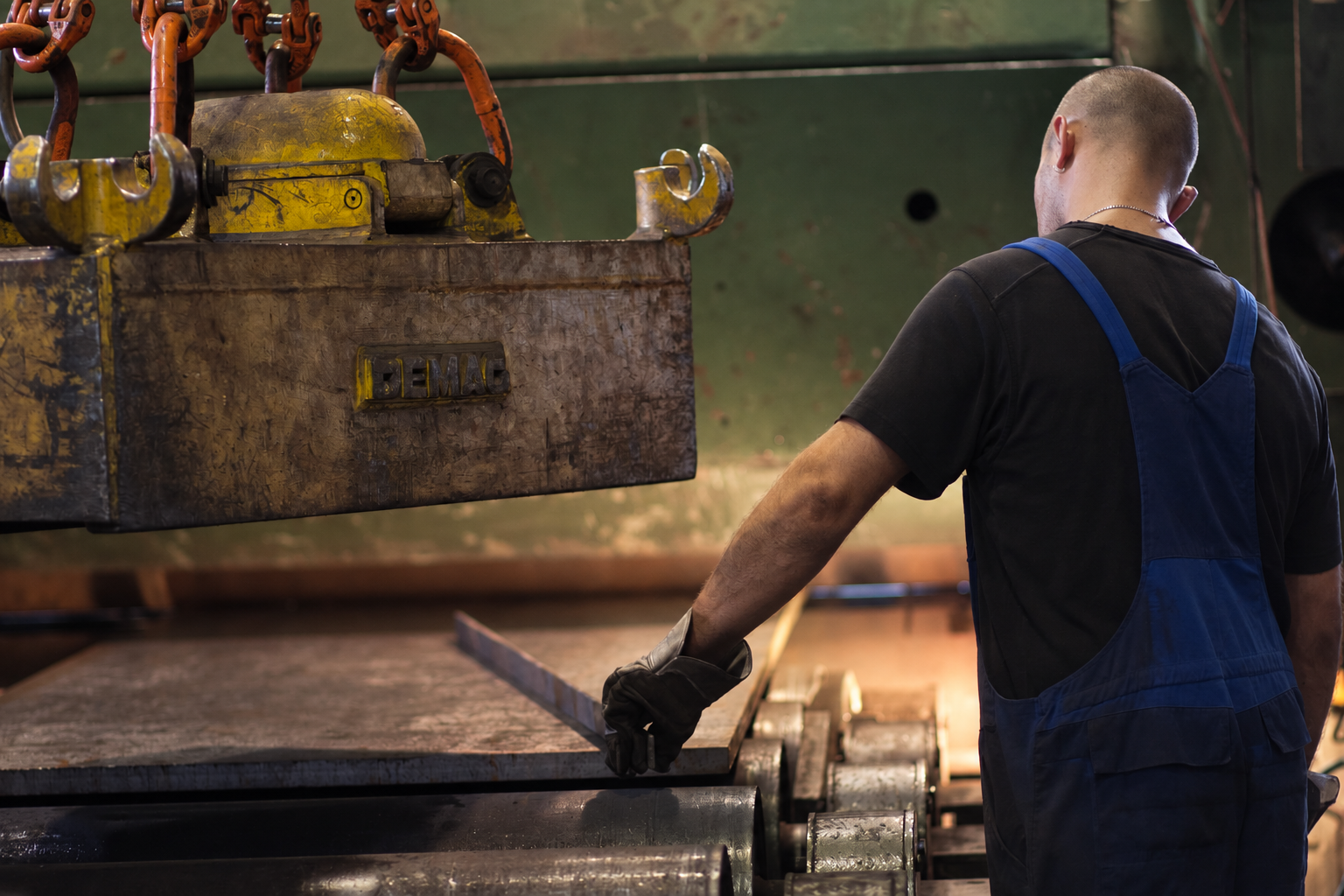
During roller levelling, the plate passes through staggered levelling rollers and is bent repeatedly in alternating directions. This can reduce unevenness and influence residual stresses. For suitable flat products and repeat parts, it provides an economical processing route.
Depending on the material, BEB uses roller levellers for plates up to approximately 30 mm thick and 3,400 mm wide. These figures describe equipment capabilities; the combination of thickness, width and material grade must be assessed for each workpiece.
Press straightening: targeted correction
In press straightening, supports and pressure points are selected to suit the deformation. Individual areas can be corrected selectively. This is particularly useful for local distortion, thicker sections or workpieces that cannot pass through a roller leveller.
BEB uses hydraulic straightening presses with forces of up to 3,000 tonnes. Depending on material and geometry, thicknesses up to approximately 700 mm are possible. Maximum press force alone does not determine the achievable shape correction.
A particular capability at BEB: one of our hydraulic straightening presses can also straighten warm material. Our roller levellers do not offer this capability.
Where the limits lie
Straightenability depends on strength, material condition, thickness and accessible support areas. Cut-outs, varying cross-sections and sensitive surfaces may impose further limits. For high-strength or hardened materials, permissible deformation and material behaviour require particularly careful assessment.
A blanket guarantee for every steel grade or flatness requirement is therefore inappropriate. A straightened workpiece should not automatically be considered completely free of residual stress. Further cutting, welding or substantial material removal can cause additional shape changes. The sequence of manufacturing steps should be part of the planning.
When straightening is worthwhile
Straightening is economically attractive when it costs less than the rework otherwise required. This may include repeated alignment in a machine, adjustments during welding, assembly corrections or scrap. The complete manufacturing chain matters.
A typical planning example is a flame-cut part that does not sit sufficiently flat before machining. Instead of using high clamping forces to compensate for the distortion, consider whether straightening first could provide a more repeatable starting condition.
Preparing your straightening enquiry
For a meaningful assessment, BEB needs the material designation and condition, length, width, thickness, quantity and weight per part. Include a drawing, photographs and details of the type and extent of deformation.
Also specify the required flatness, the relevant measurement length and subsequent manufacturing steps. This allows us to assess the processing route and agree the requirements with you.
Your next step
Let’s talk about your workpiece.
A drawing, material grade, dimensions and required result help us assess your enquiry.